Most supplement labels make you guess. VapoCept prints an amount for each of its six ingredients, so its formula can be treated like any other set of numbers: added up, split into shares and converted. This article does the arithmetic and is careful about what the results do and do not mean.
Add it up
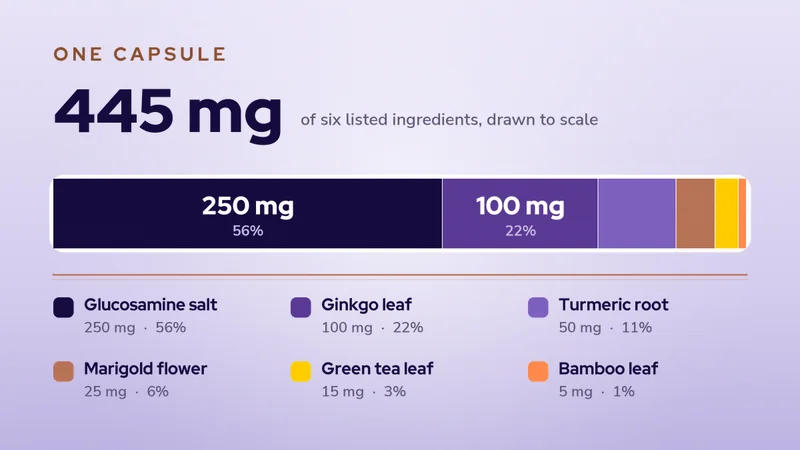
250 + 100 + 50 + 25 + 15 + 5 = 445 mg. That is the listed weight of dietary ingredients in one capsule. The capsule itself weighs more, because the gelatin shell, magnesium stearate and cellulose are not counted in the panel.
Split it into shares
| Ingredient | Per capsule | Share | Per bottle (30 days) | Per 180 days |
|---|---|---|---|---|
| Glucosamine sulfate potassium chloride | 250 mg | 56.2% | 7,500 mg | 45,000 mg |
| Ginkgo leaf extract | 100 mg | 22.5% | 3,000 mg | 18,000 mg |
| Turmeric root extract | 50 mg | 11.2% | 1,500 mg | 9,000 mg |
| Marigold flower extract | 25 mg | 5.6% | 750 mg | 4,500 mg |
| Green tea leaf extract | 15 mg | 3.4% | 450 mg | 2,700 mg |
| Bamboo leaf extract | 5 mg | 1.1% | 150 mg | 900 mg |
| Total | 445 mg | 100% | 13,350 mg | 80,100 mg |
Swipe sideways to see every column.
Two ingredients, glucosamine and ginkgo, account for 350 mg of the 445, about 79%. The last three together are 45 mg.
The order of the list matches the order of the weights, largest first, which is how a panel is normally arranged.
Turn percentages into milligrams
Three lines state a standardization, which is a promise about a named compound. Percent of a weight is a weight:
- Lutein: 25 mg of marigold extract × 5% = 1.25 mg.
- Green tea polyphenols: 15 mg × 98% = 14.7 mg.
- Catechins: 15 mg × 80% = 12 mg.
- EGCG: 15 mg × 50% = 7.5 mg.
- Silica: 5 mg of bamboo extract × 70% = 3.5 mg.
These five numbers are not printed on the label; they follow from it. They are also nested: the catechins are part of the polyphenols and the EGCG is part of the catechins, so they must not be added together.
The caffeine question, answered with subtraction
Green tea contains caffeine, and people who avoid stimulants reasonably ask how much is here. The label does not list caffeine. But if 14.7 mg of the 15 mg is polyphenols, then everything else in the extract, caffeine included, fits in 15 − 14.7 = 0.3 mg. A cup of brewed coffee has on the order of a hundred milligrams. Whatever trace this capsule carries is hundreds of times smaller.
What an extract ratio does and does not say
Ginkgo is listed as 4:1, turmeric and bamboo as 30:1. Read literally, 100 mg of 4:1 extract started as 400 mg of leaf, 50 mg of 30:1 turmeric extract as 1,500 mg of root, and 5 mg of bamboo extract as 150 mg of leaf.
It is tempting to add those up and call it the “real” dose. Resist that. A ratio describes the manufacturing input, not the content of any active compound. For ginkgo and turmeric the label names no marker, so the amount of ginkgo flavonoids or curcumin in a capsule cannot be worked out from it.
Putting a single figure in context
Numbers invite comparison, and comparison needs care. NCCIH notes that studies of ginkgo for dementia symptoms saw a modest, inconsistent effect “particularly at relatively high doses”, and that it is uncertain whether ginkgo influences cognitive performance in healthy people at all. Trials use their own extracts and amounts. A label figure tells you what you are taking; it cannot tell you that a result from a different preparation will carry over.
The same holds for glucosamine, the biggest line on the panel: NCCIH’s fact sheet discusses it for joints, where results have been inconsistent, not for focus.
What the numbers are good for
- Comparing products. With every amount printed, you can put this panel next to another and compare line by line.
- Talking to a pharmacist. “100 mg of ginkgo 4:1 extract and 250 mg of a glucosamine salt daily” is a question they can answer. “A focus blend” is not.
- Checking for overlap. If you already take glucosamine, ginkgo, turmeric or a green tea product, add the amounts before you add a capsule.
- Keeping expectations honest. 445 mg a day of plant extracts and a glucosamine salt is a small, steady input, not a drug dose.
Sources
- Product source: the VapoCept order page and the flat label artwork shown on it, the seller’s return policy and contact page, and the BuyGoods checkout, read on November 20, 2026.
- General reference: National Center for Complementary and Integrative Health. Ginkgo: Usefulness and Safety.
- General reference: National Center for Complementary and Integrative Health. Glucosamine and Chondroitin for Osteoarthritis: What You Need To Know.
- General reference: National Center for Complementary and Integrative Health. Green Tea: Usefulness and Safety.
- General reference: U.S. Food and Drug Administration. Dietary Supplement Labeling Guide: Chapter IV. Nutrition Labeling.
- Our own arithmetic: totals, cost per day, percentages and the formula figures are calculated from the prices and label values above.