VapoCept Ingredients and Label Guide
The Supplement Facts panel in full, the formula as shares of 445 mg, and a careful note on each of the six ingredients.
The Supplement Facts panel
This is the panel as printed on the flat label artwork shown on the order page. We typed it out so it can be read on a phone and by a screen reader.
Supplement Facts
Serving Size 1 capsule
Servings Per Container 30
| Ingredient | Amount Per Serving | % Daily Value |
|---|---|---|
| D-Glucosamine Sulfate Potassium Chloride | 250 mg | † |
| Ginkgo (Ginkgo biloba) (Leaf) Extract (4:1) | 100 mg | † |
| Turmeric (Curcuma longa L.) (Root) Extract (30:1) | 50 mg | † |
| Marigold (Tagetes erecta) (Flower) Extract (std. to 5% Lutein) | 25 mg | † |
| Green Tea (Camellia sinensis) (Leaf) Extract (std. to 98% Polyphenols, 80% Catechins, 50% EGCG) | 15 mg | † |
| Bamboo (Bambusa vulgaris) (Leaf) Extract (30:1) (std. to 70% Silica) | 5 mg | † |
† Daily Value not established.
Other Ingredients: Gelatin (Bovine) Capsule, Magnesium Stearate, Microcrystalline Cellulose.
Serving size and how the daggers work
The serving is 1 capsule and a bottle holds 30 servings. Every line ends in a dagger that points to the footnote “Daily Value not established”.
That is not a warning. The FDA’s labeling guide requires ingredients without an official Daily Value to be listed with their weight per serving and marked this way. It means there is no government reference intake to compare the amount with, which is true of most botanical extracts.
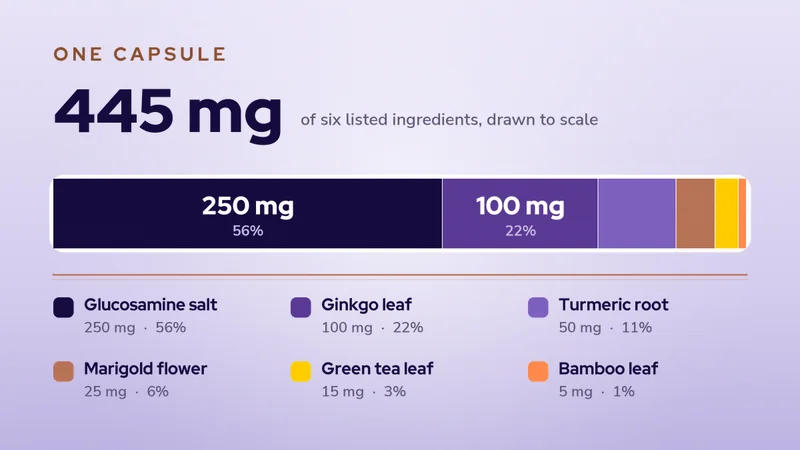
The formula as shares of 445 mg
Because nothing is hidden in a blend, the formula can be laid out exactly. The second column is the label; the other two are our arithmetic.
| Ingredient | Per capsule | Share of formula | Per 30-capsule bottle |
|---|---|---|---|
| Glucosamine sulfate potassium chloride | 250 mg | 56% | 7,500 mg |
| Ginkgo leaf extract | 100 mg | 22% | 3,000 mg |
| Turmeric root extract | 50 mg | 11% | 1,500 mg |
| Marigold flower extract | 25 mg | 6% | 750 mg |
| Green tea leaf extract | 15 mg | 3% | 450 mg |
| Bamboo leaf extract | 5 mg | 1% | 150 mg |
| Total | 445 mg | 100% | 13,350 mg |
Swipe sideways to see every column.
What “standardized to” means in milligrams
- Marigold, 5% lutein: 25 mg × 5% = 1.25 mg of lutein.
- Green tea, 98% polyphenols: 15 mg × 98% = 14.7 mg; 80% catechins = 12 mg; 50% EGCG = 7.5 mg.
- Bamboo, 70% silica: 5 mg × 70% = 3.5 mg of silica.
- Extract ratios: ginkgo 4:1, turmeric 30:1 and bamboo 30:1 nominally correspond to 400 mg, 1,500 mg and 150 mg of starting plant material. A ratio describes how the extract was made, not how strong it is; the label gives no marker compounds for ginkgo or turmeric.
The six ingredients, one by one
For each ingredient we separate three things: what the label says, what the ingredient is, and what a general reference says, if we found one worth citing. None of the references studied VapoCept itself, and the amounts in their studies are not known to match the amounts in this capsule.
D-Glucosamine Sulfate Potassium Chloride
On the label: 250 mg per capsule, the largest ingredient: about 56% of the 445 mg total.
What it is: Glucosamine is a building block of cartilage. “Sulfate potassium chloride” names the salt form, so part of the 250 mg is the potassium chloride that stabilizes it; the label does not give the split.
What can be said: NCCIH covers glucosamine as a joint supplement and calls the evidence for knee osteoarthritis inconsistent. It is not an ingredient usually associated with focus, and we found no government reference linking it to mental clarity. NCCIH notes that glucosamine may raise blood glucose in some people and has been associated with increased bleeding risk in people taking warfarin.
Ginkgo (Ginkgo biloba) (Leaf) Extract (4:1)
On the label: 100 mg per capsule of a 4:1 leaf extract.
What it is: An extract of the leaves of the ginkgo tree. A 4:1 ratio nominally means four parts of leaf were used to make one part of extract, so 100 mg corresponds to roughly 400 mg of leaf.
What can be said: NCCIH says ginkgo has been marketed for “brain health” but that it is uncertain whether it influences cognitive performance in healthy people, and that there is no conclusive evidence it is helpful for any health condition. For most adults, leaf extracts are likely safe by mouth in moderate amounts; the most common side effects are dizziness, stomach upset and headache, and ginkgo may increase bleeding risk with anticoagulants such as warfarin.
Turmeric (Curcuma longa L.) (Root) Extract (30:1)
On the label: 50 mg per capsule of a 30:1 root extract.
What it is: A concentrate of turmeric root, the yellow spice. At 30:1, 50 mg nominally corresponds to about 1,500 mg of root. The label does not state a curcumin percentage.
What can be said: NCCIH says we do not know enough to conclude whether turmeric or curcumin is beneficial for any health purpose. Conventionally formulated oral turmeric is likely safe in recommended amounts for up to 2 or 3 months; it can cause nausea, reflux or stomach upset, and liver damage has been reported with highly bioavailable curcumin formulations. This label does not describe an enhanced-absorption formulation.
Marigold (Tagetes erecta) (Flower) Extract (std. to 5% Lutein)
On the label: 25 mg per capsule, standardized to 5% lutein.
What it is: An extract of marigold petals, the usual commercial source of the yellow pigment lutein. Five percent of 25 mg is 1.25 mg of lutein per capsule.
What can be said: We did not find a U.S. government fact sheet that supports a focus claim for lutein at this amount, so we repeat none. The figure worth keeping is the arithmetic: 1.25 mg a day.
Green Tea (Camellia sinensis) (Leaf) Extract (std. to 98% Polyphenols, 80% Catechins, 50% EGCG)
On the label: 15 mg per capsule, standardized to 98% polyphenols, 80% catechins and 50% EGCG.
What it is: A purified extract of tea leaves. In milligrams, that is about 14.7 mg of polyphenols, of which 12 mg are catechins, including 7.5 mg of EGCG. Only 0.3 mg is left for everything else, which is why any caffeine can be no more than a trace.
What can be said: NCCIH says definite conclusions cannot yet be reached on whether green tea is helpful for most of the purposes it is used for. It notes that liver injury, although uncommon, has been reported with green tea extracts in tablet or capsule form, and that green tea can interact with medicines such as nadolol and atorvastatin. The amount here is small beside the extracts used in most studies, but the cautions still apply.
Bamboo (Bambusa vulgaris) (Leaf) Extract (30:1) (std. to 70% Silica)
On the label: 5 mg per capsule of a 30:1 leaf extract, standardized to 70% silica.
What it is: An extract of bamboo leaf, used in supplements as a plant source of silica. Seventy percent of 5 mg is 3.5 mg of silica; at 30:1 the extract nominally corresponds to 150 mg of leaf.
What can be said: We found no authoritative U.S. reference for bamboo extract and cognition, and we cite no health claim for it. It is the smallest ingredient, about 1% of the formula.
Other ingredients
Gelatin (Bovine) Capsule, Magnesium Stearate, Microcrystalline Cellulose.
These make the capsule itself: the shell (bovine gelatin), a flow agent used in filling (magnesium stearate) and a bulking agent (microcrystalline cellulose). Because the shell is beef gelatin, the product is not suitable for vegetarians or vegans.
Allergens
The label artwork we read carries no “Contains” statement. Glucosamine is commonly produced from shellfish shells and the label does not state the source. If you have a shellfish or other food allergy, ask the seller at [email protected] before ordering.
Warnings and storage
- Do not exceed the recommended dose.
- Pregnant or nursing mothers, children under the age of 18 and individuals with a known medical condition should consult a physician before using this or any dietary supplement.
- Keep out of reach of children.
- Do not use if the safety seal is damaged or missing.
- Store in a cool, dry place away from heat and light.
One discrepancy to know about
The label that ships reads “Supports Focus and Mental Clarity” under the product name; it is the label shown in the pictures on this website. Some bottle pictures on the order page still show an older line in that place. We describe the shipped label, the version that carries the Supplement Facts panel and the FDA disclaimer. A dietary supplement cannot be presented as a clinical treatment, and this one is not.
What cannot be concluded
The label tells you exactly what is in the capsule. General references describe single ingredients at their own doses. Neither tells you what the finished product does. The order page does not show a clinical study of VapoCept, and this site makes no claim that it treats, cures or prevents anything.
Sources
- Product source: the VapoCept order page and the flat label artwork shown on it, the seller’s return policy and contact page, and the BuyGoods checkout, read on November 20, 2026.
- General reference: U.S. Food and Drug Administration. Dietary Supplement Labeling Guide: Chapter IV. Nutrition Labeling.
- General reference: National Center for Complementary and Integrative Health. Glucosamine and Chondroitin for Osteoarthritis: What You Need To Know.
- General reference: National Center for Complementary and Integrative Health. Ginkgo: Usefulness and Safety.
- General reference: National Center for Complementary and Integrative Health. Turmeric: Usefulness and Safety.
- General reference: National Center for Complementary and Integrative Health. Green Tea: Usefulness and Safety.
- General reference: U.S. Food and Drug Administration. Questions and Answers on Dietary Supplements.
- Our own arithmetic: totals, cost per day, percentages and the formula figures are calculated from the prices and label values above.