How VapoCept Works
One capsule a day, a fixed time, and enough weeks to judge it. Here is the routine and what stands behind it.
The short version
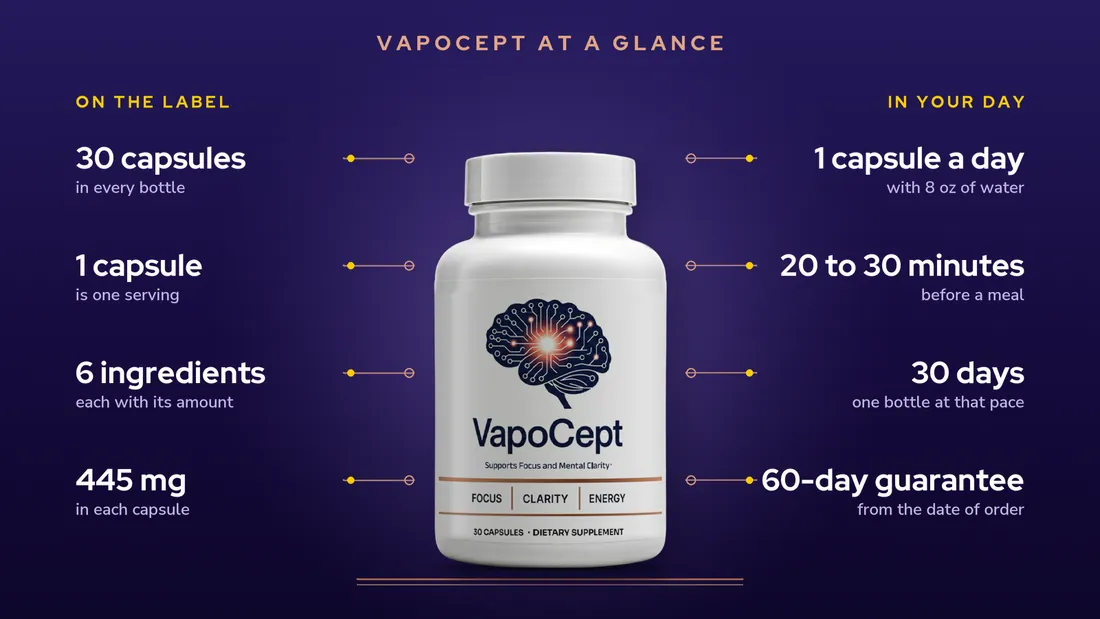
VapoCept is used by taking 1 capsule a day with water. That capsule carries 445 mg of 6 ingredients, which the label associates with focus and mental clarity*. What follows explains the routine and stays inside what the label and general references support.
The routine in four steps
Take one capsule
Once a day with an 8 oz glass of water, as the label says.
Fix the time
The label suggests 20 to 30 minutes before a meal. Pick one meal and keep to it.
Stay consistent
A bottle covers 30 days. Skipping days makes it harder to judge anything.
Review before day 60
The refund window runs from the order date.
What the seller says the formula does
The order page describes VapoCept as “targeted nutritional support for daily mental clarity, sustained energy, and overall cognitive well-being”*, and the label puts it in four words: supports focus and mental clarity*. Those are the maker’s statements. The page does not link them to a trial of the finished capsule.
What general references support
- Ginkgo leaf extract (100 mg): NCCIH says supplements containing ginkgo have been marketed for brain health, but it is uncertain whether they influence cognitive performance in healthy people, and much of the research is of low quality.
- Green tea extract (15 mg): NCCIH says definite conclusions cannot yet be reached for most uses. The extract here is nearly all polyphenols, so it is not a meaningful source of caffeine.
- Turmeric root extract (50 mg): NCCIH says we do not know enough to conclude whether turmeric or curcumin is beneficial for any health purpose.
- Glucosamine (250 mg): studied mainly for joints, with inconsistent results according to NCCIH. It is the largest ingredient by weight.
- Marigold and bamboo extracts: they supply 1.25 mg of lutein and 3.5 mg of silica. We found no government reference to cite for a focus effect at those amounts.
In other words, the mechanism on the label is modest: a small daily amount of several plant extracts and a glucosamine salt, with no stimulant listed. Whether that adds up to something you notice is individual, and it is exactly what the 60-day guarantee exists to let you find out.
Why the label says “before a meal” and “with water”
The label gives the instruction without a reason, and we will not supply one it does not state. Practically, a glass of water helps a capsule go down, and tying the capsule to a meal gives it a fixed place in the day. If taking it on an empty stomach bothers you, ask the seller or your pharmacist whether taking it with food is acceptable.
Questions about use
How do you take VapoCept?
The label says: as a dietary supplement, take one (1) capsule daily with an 8 oz. glass of water. For best results, take it 20-30 minutes before a meal with 8 oz of water, or as directed by your healthcare professional. Do not exceed the recommended dose.
Can I take more than one capsule a day?
The label says no: “Do not exceed recommended dose.” The recommended dose is 1 capsule daily.
Does VapoCept contain caffeine?
Caffeine is not listed as an ingredient. The only possible source is the 15 mg of green tea extract, which the label says is standardized to 98% polyphenols. That leaves 0.3 mg of everything else in the extract, so any caffeine in a capsule is at most a fraction of a milligram. The label itself makes no “caffeine free” statement.
How soon will I notice anything?
Neither the label nor the order page gives a timeline, and we will not invent one. People respond differently to supplements, and some notice nothing. A practical approach is to take it as directed, daily, and judge it inside the 60-day refund window.
How long does one bottle last?
30 days. A bottle holds 30 capsules and the serving is 1 capsule a day, so 2 bottles cover 60 days, 3 cover 90 and 6 cover 180.
How should I store it?
In a cool, dry place away from heat and light, out of the reach of children. Do not use it if the safety seal is damaged or missing.
Questions about safety
Can I take VapoCept with medication?
Ask your doctor or pharmacist first. Three of the six ingredients have documented interactions: NCCIH notes that ginkgo may raise the risk of bleeding in people taking anticoagulants such as warfarin; glucosamine has been associated with an increased bleeding risk with warfarin as well; and green tea extract can lower blood levels of some medicines, including nadolol and atorvastatin.
I have diabetes. Is there anything to know?
NCCIH reports that glucosamine may raise blood glucose levels in some people. A capsule contains 250 mg of a glucosamine salt. If you have diabetes or monitor your blood sugar, talk to your doctor before taking it.
What side effects are possible?
VapoCept itself has not been the subject of a published study that we could find, so the honest answer comes from its ingredients. NCCIH lists dizziness, stomach upset and headache as the most common side effects of ginkgo leaf extract; nausea, reflux and stomach upset for oral turmeric; and nausea, constipation, abdominal discomfort and increased blood pressure for green tea extract supplements. If you notice a side effect, stop and speak to a health care provider.
Can I take it while pregnant or nursing?
The label tells pregnant or nursing mothers to consult a physician before using this or any dietary supplement. NCCIH states that ginkgo may be unsafe during pregnancy and that turmeric supplements during pregnancy may be unsafe. Do not use it without your doctor’s agreement.
Should I stop before surgery?
Tell your surgical team about every supplement you take, well ahead of time. NCCIH warns that certain supplements may increase bleeding risk or affect anesthesia, and ginkgo is one with a known bleeding caution. Follow your surgeon’s instructions.
Sources
- Product source: the VapoCept order page and the flat label artwork shown on it, the seller’s return policy and contact page, and the BuyGoods checkout, read on November 20, 2026.
- General reference: National Center for Complementary and Integrative Health. Ginkgo: Usefulness and Safety.
- General reference: National Center for Complementary and Integrative Health. Green Tea: Usefulness and Safety.
- General reference: National Center for Complementary and Integrative Health. Turmeric: Usefulness and Safety.
- General reference: National Center for Complementary and Integrative Health. Glucosamine and Chondroitin for Osteoarthritis: What You Need To Know.
- General reference: National Center for Complementary and Integrative Health. Using Dietary Supplements Wisely.
- Our own arithmetic: totals, cost per day, percentages and the formula figures are calculated from the prices and label values above.